I grew up in a world rooted deeply in tradition where values weren’t just taught, they were lived. In my small corner of rural Kenya, my mother was the anchor of our home. In the Maasai community, it is the mother who raises the children teaches them, molds them, prays for them, and gently pushes them toward the people they must become. The father, by custom and expectation, is mostly absent not out of neglect, but duty. He is out in the world, gathering resources, building wealth, extending the family name.
In the traditional Maasai way of life, wealth wasn’t found in bank accounts but in the size of your herd and the stretch of your lineage. The more children a man had, the wealthier he was perceived to be. Daughters were especially seen as investments married off in exchange for cattle, which added to the family’s prominence. In this setup, the mother became the silent architect of her children’s future, while the father was often the enforcer of discipline.
So when I say my mother raised me, I mean she instilled in me an entire belief system one laced with Christian virtues and cultural expectations. From her, I learned honesty, humility, empathy, service to humanity and God, gratitude, and reverence for our roots. She taught me never to forget where I come from, never to let success swell my head, never to look down on anyone no matter the position they occupy in society’s constructed classes. She emphasized charity—that there is always someone with less, and it is our duty to reach out. And most importantly, she taught me gratitude, reminding me always to be like the one leper who turned back to thank Jesus for his healing.
But what happens when these values are carried into a world that doesn’t always reward them?
Now, here I am a Maasai woman in Europe, walking between worlds. Navigating a culture that is built so differently from the one I was raised in. Living in societies that reward assertion, boldness, and visibility. And in doing so, I’ve come to a hard, sometimes painful realization: some of the very virtues that shaped me can, in certain environments, become obstacles.
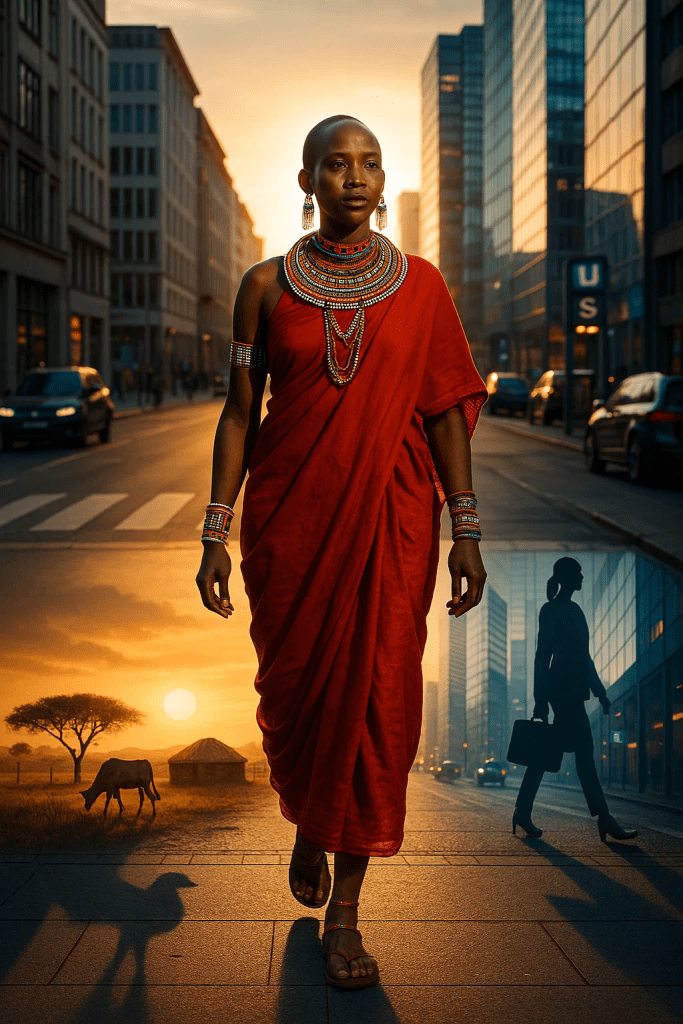
Humility, for example, is beautiful at home. But in the corporate world, humility becomes invisibility. It makes you easy to overlook, easy to micromanage, and easy to discard. Being quiet and competent doesn’t always earn you respect it earns you silence. And that is a silence I have had to fight my way out of. I’ve learned that finding your voice is not just important it is necessary. Because without it, you disappear in rooms you deserve to stand out in.
Life in Europe has broken and humbled me in ways I never expected. And in that breaking, I’ve lost my attachment to modesty. I once admired it as a virtue until I read Maya Angelou’s words and felt them crack open my understanding:
“I will not be modest. Modesty is a learned affectation. And as soon as life slams you against the wall, that modesty will drop off faster than your skirt in an unguarded moment.”
I now understand what she meant.
Living in Europe has been my Bhutan. As some people travel to Bhutan to hike its mountains and find themselves, Europe has been my spiritual ascent. A long, internal climb. A kind of pain that isn’t physical but deeply rooted within the pain of being isolated so that you can be elevated. An elevation that doesn’t announce itself with titles or applause, but with a deeper connection to self, to truth, and to purpose.
Would I trade this life for anything? No.
I appreciate the pain.
Because this pain has unearthed a new version of me one that stands tall in unfamiliar lands, even when my voice shakes. One who understands that strength is not in suppressing who I am, but in standing fully in it. My upbringing didn’t just prepare me for survival. It prepared me to reflect, to question, to unlearn and relearn.
Walking between worlds is not easy.
But it is the only way I know how to live now with one foot rooted in the sacred soil of my Maasai heritage, and the other stepping forward, firm and intentional, into a world I am still discovering.
And as I bloom in this foreign soil, I carry both worlds with me.


 The Blooming Maasai
Leave a comment