From a young age, I sensed I was meant for a bigger life one that didn’t fit the script handed to me. Growing up as my mother’s youngest child in a vast Maasai village, I had no siblings to play with. Our isolation was no accident; it was the legacy of colonial theft.
When the British came, they didn’t just take our land they rewrote our future. They bribed Oloibon Lenana, our leader, into signing the Anglo-Maasai Agreement of 1904, stripping us of fertile highlands and pushing us into arid reserves. Overnight, we became nomads, our survival tied to cattle. This was the unspoken backdrop of my childhood: a village scattered thin, neighbors kilometers apart, and a people learning to endure.
My cousin’s arrival was a gift, a rare companion in that lonely expanse. But when I left for private school in town, I saw the world beyond our village, and it unsettled me. The women I loved, my mother, her friends lived lives of quiet exhaustion. Fetching water. Tending livestock. Marrying young.
I wanted more.
Back home, girls my age were already wives, mothers. Pressure mounted for me to follow. But I refused. My resistance wasn’t rebellion it was the first whisper of a self I was determined to become.
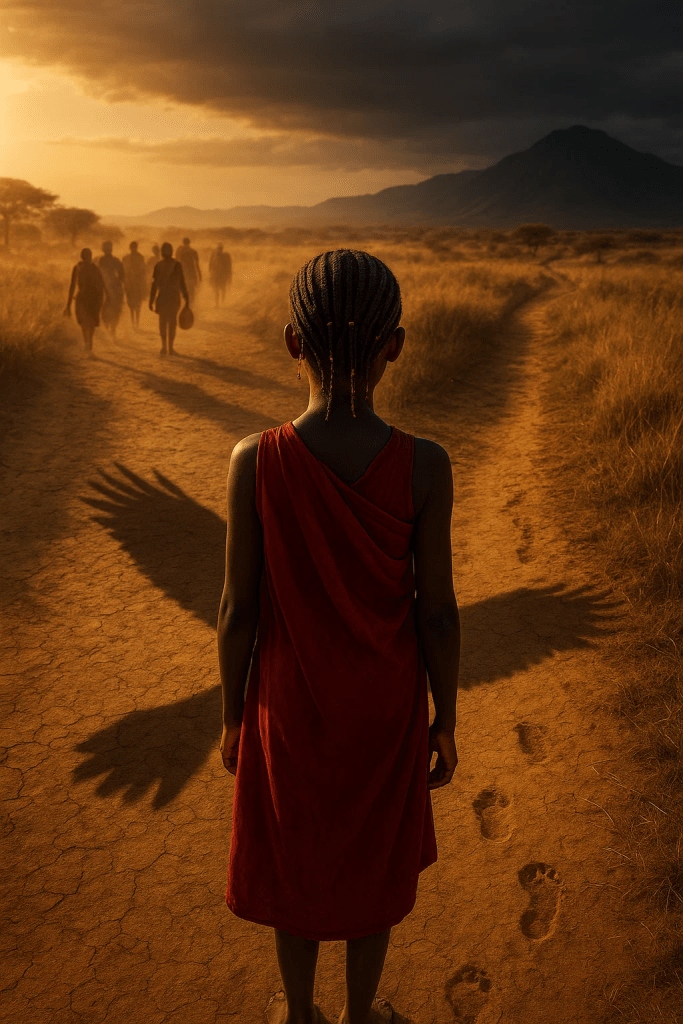
Visuals generated using AI, edited to reflect my journey as a young girl who dared to dream
Kenya was beautiful, but its systems were rigid. For those without connections, talent alone wasn’t a ladder it was a taunt. I watched brilliant friends stall in unemployment while the well-networked soared. The injustice gnawed at me.
One night, under a sky heavy with stars, I made a vow. I wouldn’t just leave Kenya. I would leave Africa’s airspace. The words felt dangerous, but they tasted like freedom. I repeated them until they became part of me.
So I left.
The Netherlands was a study in contrasts. I traded Nairobi’s chaotic warmth for a silent, concrete rhythm. Days passed without conversation. In winter, the streets felt empty except for the echo of my own footsteps, the sharp bite of cold on my cheeks, the hum of bicycles cutting through fog. The systems here were coldly efficient, designed to remind immigrants they were guests, not equals. I’d dreamed of “better,” but I learned this: no soil grows you like home.
Yet, in the loneliness, I grew.
I became more Pan-African, more aware of how this place would always mark me as “other.” Here, competence requires proof in duplicate; trust is a currency rarely spent on outsiders. The pressure to cut corners hums in the background, but I refuse. Shortcuts are bad cuts they steal from the person you’re becoming.
Like the Samurai, I choose honor. Like my Maasai ancestors, I choose resilience.
This journey has been lonely. But every step carved me closer to the woman I’m meant to be. Someday, I’ll look back and smile not because it was easy, but because I paid courage’s price in full. And the cost was worth every coin.


 The Blooming Maasai
Leave a comment