When I left home, I carried no heirlooms, no land, no riches. What I packed instead were my mother’s whispered prayers unseen, weightless, yet heavy enough to shape the woman I am becoming.
My mother is the eldest of twenty children. My grandfather, like many Maasai men of his time, had two wives. Polygamy was a measure of wealth, for a man’s power was counted not in coins but in cattle, wives, and children. As the firstborn daughter, my mother grew up too fast. She was her mother’s second pair of hands, raising younger siblings before she was even done being a child herself.
In Maasai culture, women are the quiet architects of resilience. They rise before the sun, walk miles for firewood and water, and shoulder the weight of households while traditions weigh heavily upon them. Yet their sacrifices often go unseen, wrapped in silence by taboos that forbid open lament. A Maasai woman is expected to endure without complaint to honor resilience by not showing weakness, even when the cost is her body, her dreams, or her voice.
Marriage came early for her, as it does for many Maasai girls, but not without careful calculation. My mother was Nkidongi, a clan revered for its spiritual ties to prophecy and healing. My father was Loodokishu, a lineage known for warriors and scholars. Though their clans were different marrying within one’s clan would be like marrying a sibling, a violation of kinship laws their union was more than permissible; it was auspicious. The Nkidongi blessings and the Loodokishu ambition intertwined like roots of the same acacia tree. My father, a university graduate, was a jackpot by local standards. But it was the unspoken alchemy of their clans that lent their marriage its quiet strength: hers, the lineage of seers; his, the lineage of strategists. Together, they carried the promise of something new.
So she left her family and built another, bearing children, carrying responsibilities, supporting her husband’s dreams while hers remained shelved. Marriage, as they say, is not a bed of roses. Years passed. Youth slipped away. When she looked back, her greatest accomplishment was not degrees or titles, but her children.
She never hid her struggles from us. We saw her rawness and her vulnerability. Some days her pain was heavy, but so was her determination. She reminded us daily that education would take us far though, as a teenager, I often let her words go in one ear and out the other. Only now, abroad, I see how right she was. Education was the key that unlocked doors my mother never had the chance to open.
Still, I carry grace for the women around me who made different choices. Many had no better options. Each generation of Maasai women inherited both strength and struggle, doing the best they could with what they had. They are the web that holds our community together building manyattas, herding cattle, raising children, carrying households on their shoulders. Without them, the Maasai would not stand.
I know this life. I herded cattle under the scorching sun. I cared for children during school breaks. I learned to run a household while still a child myself. This was how girls were prepared for marriage. But instead of admiring that path, I wondered: Could there be something more?
And then, there were my mother’s prayers. For years, I’d dreamed of leaving the African airspace, restless for horizons beyond our homestead. Few months before my journey to the Netherlands, my mother pressed her hands to my head. “You will cross oceans,” she whispered, “and when you land, you will soar like an eagle.” At the time, it felt like poetry. But when I stepped off the plane into a world where no one knew my name, her words became my spine. I remembered them when I faltered when the winters were too cold, when the language was too sharp, when I wondered if I’d made a mistake. Her prayers were not abstract; they were the wind beneath my wings, just as she’d promised.
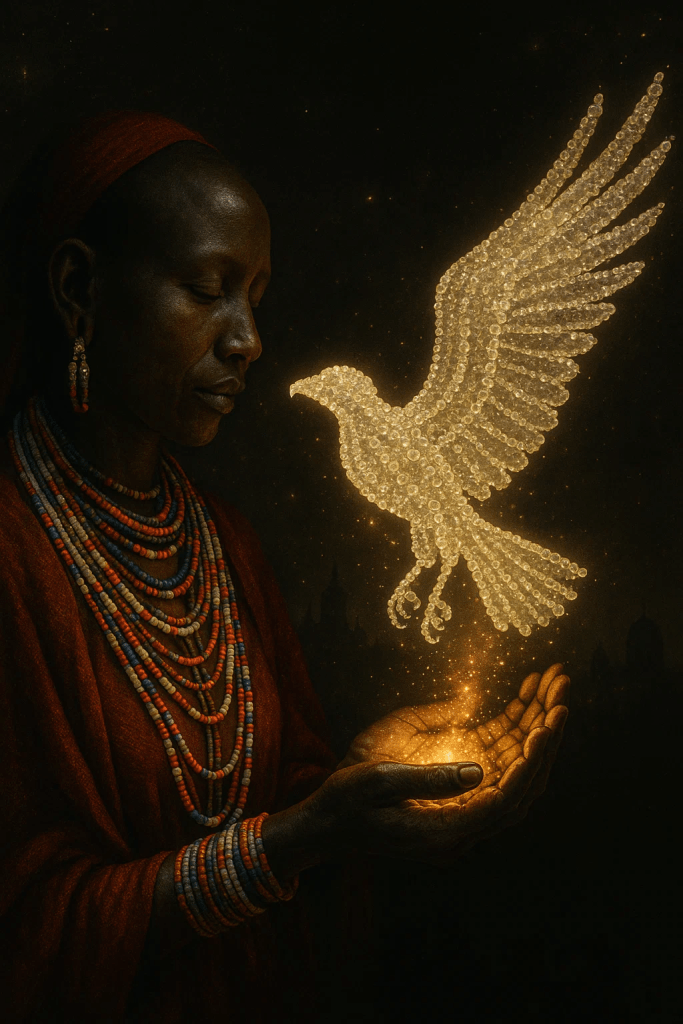
For the past ten years, she has risen at 5:00 every morning to pray for each of her children by name. She tells God our needs, our struggles, our triumphs, and even our missteps. When we falter, she “reports” us to God a reminder of both her discipline and her love. These unseen prayers have been my inheritance a shield of protection, a compass of guidance, and the secret currency that carried me farther than circumstances alone ever could.
Now, I live between two worlds. In Europe, I walk in the freedoms of a liberal society choice, autonomy, voice yet I carry the grounding force of her prayers and the memory of women who endure where opportunities are scarce. My reinvention is not mine alone; it is a continuation of her sacrifice.
I am my mother’s wildest dream and her quietest prayer. She paid for my courage in silence, in surrender, in dawns spent whispering my name to a God who listens. I pay for it now by daring to bloom in foreign soil, by turning her sacrifices into wings. And when the distance between us feels too wide, I remember: the prayers she packed for me are still here, humming in my bones, pulling me forward. They have no weight, no borders. They are the one thing I could never leave behind.


 The Blooming Maasai
Leave a comment