This is the stark reality for countless women across Africa, a story I know intimately because it is the story of my community. Pressed to the margins of formal financial, political, and infrastructural systems by a potent mix of patriarchy, poverty, and lack of access, they are told their world is meant to be small.
Her political ambition is dismissed before she speaks. Her dream of a loan is laughed away at the bank. Her need for a safe road to the market is ignored by planners. Her exclusion isn’t about a lack of merit; it’s about being a woman in a system designed to keep her in her place.
If you look closely at these margins, you will not find resignation. You will find a forge where, resilience is not a buzzword from a donor report but a daily practice. It’s the quiet, daily work of a whispered plan between neighbors, the folded cash passed between hands in a savings group, the unspoken promise to watch a friend’s child. This is not a story of charity; it is a story of breathtaking innovation and governance from below where women are building their own world.
When the formal economy shuts its doors, women create their own. They form chamas and table banking groups, transforming meagre savings into collective capital. When infrastructure fails them, they build their own safety nets. An informal childcare system, rooted in the profound belief that “it takes a village to raise a child,” through rotating childcare, where the responsibility for the community’s children becomes a shared duty freeing a mother to earn or learn. And though they are too few, knowledge-sharing networks become their underground universities.
The scarcity of these knowledge platforms highlights a critical gap: the transformative power that could be unleashed if women from marginalized communities had dedicated spaces to seek guidance, share skills, and scale their solutions.
To understand the depth of this innovation, let’s walk in the shoes of one woman, a composite of thousands.
Her world is full of walls she cannot climb. Her husband tells her, “Your place is here at home,” and so she has no money of her own. It feels like a cage. She feels the bars every time there is not enough food, and every time she sees her children’s faded, torn school uniforms.
But the walls are also made of the world around her. The daily hunt for firewood scrapes the land bare. The thick, smoky air from her cooking fire makes her children cough and cling to her, their school clothes holding a smell that other children mock. When the sun sets, the dangerous smoke from the fire is replaced by the choking fumes of a kerosene lamp, its dim light making it almost impossible for her children to do their homework.
She is caught at the intersection of gender inequality, economic poverty, and climate vulnerability.
But her breaking point becomes her turning point. She joins a chama. It is more than a savings group; it is a sisterhood of resilience. Here, she finds her voice and her strategy.
Together, they tackle their challenges not as isolated issues, but as interconnected parts of their lives:
- Energy & Health: They negotiate a bulk purchase of clean cookstoves, affordable on a payment plan. The result? Immediate health benefits for their children and a drastic reduction in the wood they need to collect, the time they spend collecting firewood and preserving the local environment.
- Education & Light: They invest in solar lamps. Now, children can study safely at night, and the lamps often equipped with radios become a vital link to news, markets, and community announcements.
- Economic Resilience: Her weekly savings of 500 shillings (enough for a family’s daily meal), once unimaginable, become a lifeline. The annual dividend isn’t just money; it’s a seed for a small business, insurance for a medical emergency, or a buffer against a failed harvest.
This is holistic resilience where she is not just adapting to climate change by reducing deforestation; she is building economic power. She is not just lighting her home; she is educating the next generation. She is fighting poverty with her bare hands, and she is winning.
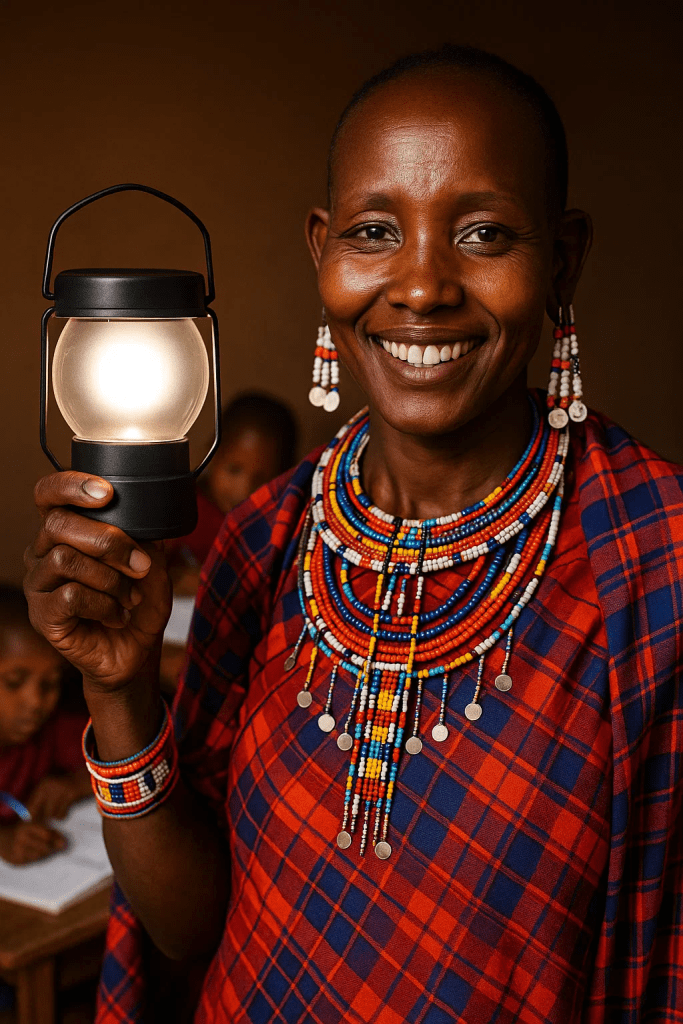
This is just one home. Multiply this by a community, and you see a blueprint for sustainable development. Imagine chamas collectively investing in drought-resistant seeds, pooling resources to build water-harvesting systems, or creating community-owned solar microgrids.
The lesson for global development is profound: solutions work best when they are woven together, not delivered in separate boxes. A project that brings clean cookstoves will have a much deeper impact if it also helps a woman gain financial independence. A program promoting climate-smart seeds will be more successful if it also addresses the traditions that can prevent women from owning the land they farm.
True progress requires us to listen, learn, and lift up the systems women have already built. It means directing funding and support to these grassroots networks, trusting women to identify their most pressing needs and innovate their own solutions.
The margins are not the edge of the story; they are the source. In the quiet hum of a women’s meeting, under the glow of a shared solar lamp, a sustainable, adaptable, and resilient future is being built. One woman, one innovation, one community at a time.
A Note on the Art: The image in this article is AI-generated.


 The Blooming Maasai
Leave a comment