There is a silence that is taught, not born. It is learned by a young girl in a Maasai manyatta when she sees her mother’s posture change; the straight back that carried a heavy water pot now softening into a deferential curve as her father approaches. It is a silence that speaks of a world where a woman’s voice is secondary to a man’s presence. This is the first and heaviest inheritance: the weight of a tradition that demands her quietness.
This inherited silence is not a Maasai story alone.
A generation ago and many countries away, the same silence lived in the compound of Okonkwo in Umuofia the fictional Igbo village in Chinua Achebe’s seminal novel, Things Fall Apart. In that story, just as in ours, the fate of women was dictated by the same unwritten rules of duty and deference. The details of the culture such as the red ochre versus the kola nut, the spear versus the yam are different. But the experience of the women is a painful, universal echo.
The Knight and The Sacrificial Lamb
A man is often seen as the knight in Maasai regalia. Adorned with red ochre, spear and shield in hand, a symbol of strength and protection. Yet, for the woman, this ideal can cast a long shadow. She is often positioned as the sacrificial lamb.
Her value is transactional: the dowry she brings is wealth that finances her brothers’ school fees, or enables her father to marry a younger wife to bear more sons. She serves, she labours, she builds the home, yet when the man becomes a respected elder, her role in his ascent is rarely acknowledged. She is the foundation, invisible but essential, bearing the weight of an honour she never gets to share.
This is a script that was written long before her time. In Chinua Achebe’s Umuofia, a man’s worth was measured by his titles, his yams, and the number of wives he could sustain. The women were the instruments of this success. Their labour farming his fields, their bodies bearing his children, their silence maintaining his compound’s order.
The Maasai knight and the Igbo titled man are brothers in ideology; both systems are built upon the same quiet, relentless labour of women.
A Chorus of Silence: When the House Becomes Hush
The weight manifests in a daily, quiet storm.
A man, believing he must prove his authority, may punish his wife for a mistake that was never hers to make like when a few goats stray from the field. When he comes home, the house becomes hushed, a sanctuary turned into a courtroom where she is always the accused.
This scene is hauntingly familiar. We saw it in Umuofia when Okonkwo, in a fit of rage, broke the sacred Week of Peace by beating his youngest wife, Ojiugo, for neglecting her meal. Her transgression was minor, but his response was about asserting control. The parallel is stark: whether for a lost goat or a late meal, a woman’s mistake becomes a platform for a man to perform his dominance, and the home must absorb the resulting silence.
The Cycle
The greatest irony, the one that tightens the chain, lies in the hands of the mothers. A woman who has known no other life, whose own worth was tied to this system, will often encourage her daughter to walk the same path. How can a “blind rat” lead others to safety? She pushes her daughter into the very system that confined her, believing it to be the only way to secure her future.
In Things Fall Apart, the mothers themselves are products of this cycle. They teach their daughters the duties of submission, preparing them for a life not unlike their own. They do this not out of malice, but from a place of profound helplessness. Helpless against the gossip of the community, helpless without resources, and helpless at the thought of a failed marriage. So, the wheel turns, generation after generation.
The Daughter as the Cycle-Breaker
But a new wind is blowing. A daughter, witnessing her mother’s silent struggles, grows tired of the cycle. She realizes no one is coming to rescue them. Not her mother, who is trapped by circumstance, and certainly not a Moran in traditional regalia. So, she decides to rescue herself.
She chooses a different path. She clings to education as her spear and shield. She graduates, she pursues a career, she builds a life on her own terms. And in her success, she becomes her mother’s unexpected saviour. She is the living alternative to the path of silence. She opens her mother’s eyes to the injustices she normalized for decades. “Leave,” she says. “You have held onto a loveless marriage for us, but now we are grown. There is nothing to hold you back.”
The Mother’s Reinvention: The Price and The Prize
And so, the mother begins to reinvent her life. With her daughter’s strength as her catalyst, she steps out of the shadow. The years of experience and resilience that once weighed her down now become her greatest asset.
One day, her daughter asks her, “Mother, if you could become a young woman again, what would you do differently?”
The mother looks into the distance, her eyes holding a lifetime of memory. She thinks of the missing teeth and the blows she endured for minor mistakes, like the time the cows were stolen by cattle rustlers. She remembers the constant weight of expectation to bear sons, and the silent shame when she didn’t. She feels the ghost of the exhaustion from laboring in the fields and in the home, only for her contributions to be invisible when her husband’s success was celebrated. She recalls the powerlessness of watching her own daughters being prepared for the same path, pressured to marry early to bring a dowry that would enrich the family.
“I would not get married,” she says, the words simple, stark, and heavy with the weight of these unspoken memories. Then, a soft smile touches her lips as she looks at her children. “But still, the biggest blessing from it all was having you. So, you see, the price I paid came with the prize: My children.”
She turns to her daughter, her gaze firm and clear. “This is why you must live differently. Do not be a victim of the past you witnessed. The past I endured, your aunties endured, your grandmother endured. We carried that weight so you could learn to put it down. Your life does not have to be a mirror of our pain. Use your education. See the world. Choose a man who sees you as a partner, not a servant. And if you choose no man at all, that is a valid choice too. Your value was never in the dowry you could bring or the sons you could bear. Your value is in your mind, your spirit, and your freedom. That is the life I want for you.”
The Cycle is Broken
This revelation becomes her final liberation.
Having paid a heavy price, she is determined that her daughters will not pay the same. She becomes their fiercest protector. She does not let anyone pressure her daughters into traditions that do not serve them. They are free to learn, to travel, to love, and to choose their own life paths.
The mother, once the silent foundation of a man’s legacy, now stands tall as the architect of her daughters’ futures. She sees her defiant daughter not as a strayed child, but as her answered prayer: The cycle-breaker that she didn’t know she was waiting for.
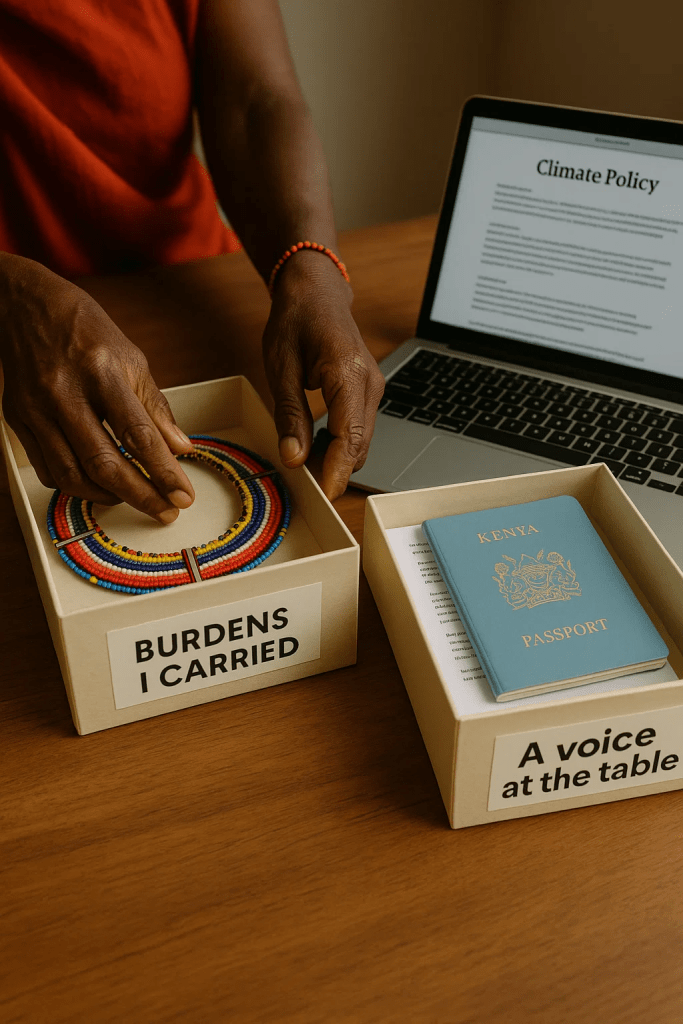
The house no longer hushes when a man enters. Instead, it rings with the voices of women who know their worth, who have sifted through tradition, choosing to carry forward its beauty and leave its weight behind.
Finally, the cycle is broken.
A Note on the Art: The images in this article are AI-generated.


 The Blooming Maasai
Leave a comment